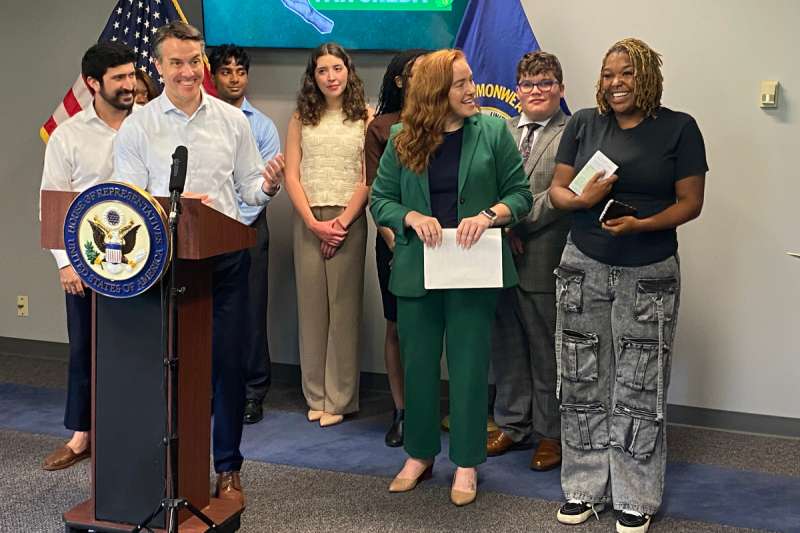
Shanna Moore knows what it is like to get that extra boost when you’re just starting out.
A few years ago, she was one of 151 young people—ages 18 to 24—in a guaranteed income pilot project in Louisville. The deal: $500 a month for a year, no strings attached.
Speaking at a Wednesday morning press conference in downtown Louisville, Moore said the money helped her afford rent and groceries each month, making it easier to focus on her studies without stress.
“This made it easier for me to focus on things that mattered to me, such as my future, what I wanted to do, and who I wanted to be,” Moore said Wednesday. “I’m so much closer to who I want to be.”
As a whole, the program’s participants were more likely to be working full-time, with about half using the money to pursue education or job training. They were also 70% less likely to be evicted.
Buoyed by Louisville’s success, US Rep. Morgan McGarvey, a Democrat representing Kentucky’s 3rd congressional district, announced Wednesday he is filing legislation to bring a similar program to young adults across the country.
Those in the 18-to-24 age bracket are at a point in life, McGarvey said, “where a stumble out of the gate can impact you for the rest of your life.”
It is particularly pressing now, McGarvey continued, as young people are “facing an absolutely horrendous economy with rising prices all the time due to Donald Trump’s war in Iran, due to Donald Trump’s tariff prices.”
Under the proposal, 18 to 24-year-olds would get a $500 monthly tax credit. It could go to a range of things, including higher education or job training, help with rent, keeping food on the table, or making it easier to get to work or class.
There are no specific work requirements, McGarvey said, but recipients would have to apply for the program and “be involved in some way.” He told reporters he believed “nearly all” of the people in that age range would qualify.
McGarvey’s pitch is modeled on Metro United Way’s YALift! Program—the one Moore was part of.
“Young people face skyrocketing housing and education costs, stagnant wages, and a safety net that wasn’t built with them in mind,” Liz McQuillen, chief policy officer for Metro United Way, said Wednesday. “So, we gave young adults the flexibility to make decisions for themselves, which is a different approach than traditional service delivery, and the results really reflect that.”
Recipients were more likely to be working full-time, and about half used the money to pursue education or job training. They were also 70% less likely to be evicted.
“Beyond those numbers, participants reported something just as important: less stress, because when you stabilize someone’s financial footing during one of the most formative times of their life, everything else starts to stabilize, too,” McQuillen said.
US Rep. Greg Casar—a Texas Democrat and chair of the Congressional Progressive Caucus—joined the event in Louisville, adding the bill is just one part of the caucus’ agenda to tackle cost-of-living and affordability issues.
The estimated cost of the program is still being determined, but McGarvey said he hopes the end result reflects not just the immediate straight cost to the government, but the larger impact of investing in young people. Louisville’s pilot project signaled that recipients weren’t just keeping the money, but investing it in their communities and themselves, he said.