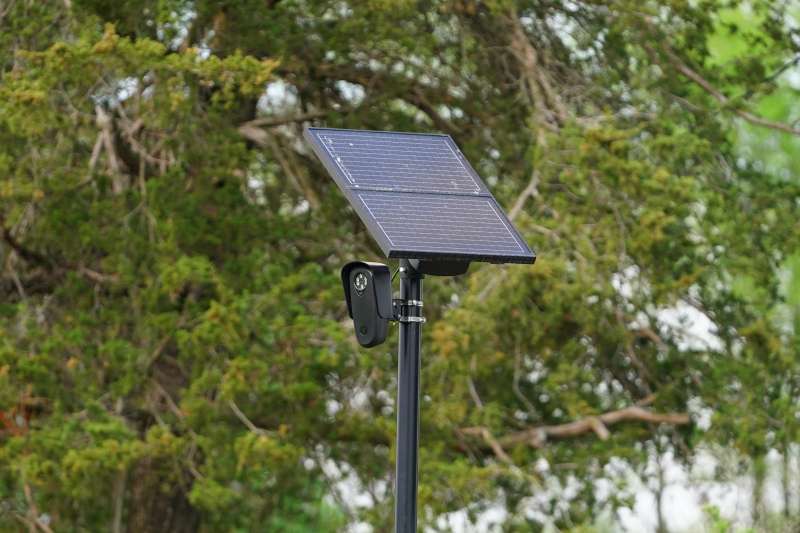
More and more Northern Kentucky police departments are looking to install AI-powered surveillance cameras along public roads and in public spaces, but they’re meeting strong resistance from a diverse range of residents, business owners, tech experts, local activists, political hopefuls and elected officials on both sides of the aisle.
Want Queer Kentucky’s latest in your inbox? Sign up for our newsletter here.
Most recently, at Kenton County Fiscal Court’s July 14 meeting, the message was unified and clear.
“I don’t feel safer in a community with more surveillance,” one county resident told commissioners during public comment. “I don’t feel my family is safer, my neighbors are safer because police have access to more cameras in the community.”
More than a dozen people spoke against Kenton County Police Chief Spike Jones’ request for six Flock Safety-brand automated license plate reader cameras (ALPRs) to monitor vehicles visiting county parks and the jail. No speaker supported installing the cameras, which go beyond reading license plates. Using artificial intelligence, they also record additional identifying characteristics like vehicle make, model, color, and other markings like dents, decals or customizations, and store that information in searchable databases. These cameras document every vehicle that passes, not just vehicles already connected to suspected criminal activity.
The recent pushback in Kenton County is part of a growing chorus of voices across the region (and country) uniting against the new technology.
What exactly are police asking for?
Before public comment, Jones laid out his request, promising the cameras would only monitor entrances to county properties and would not track nearby vehicles on the road. They would not have biometric-screening capability like facial recognition, and local data storage would expire after 30 days unless tagged as part of an investigation by an ALPR-certified officer. They would not be used for traffic enforcement.
“We see this as a way to keep potential predators from coming into our parks and preying on children,” Jones said. “This will add a layer of security for folks coming to enjoy these beautiful spaces that the Court works so hard to maintain.”
Jones presented data showing more than 1,000 reports of “suspicious activity or person” across the county’s seven parks over the last five years. Jones said the cameras would help his stretched roster of officers cover the parks more effectively and shared anecdotes from his peers affirming the cameras’ value.
“It’s not to create an Orwellian society, as some have thought,” Jones said. “But we want to take care of our parks, and other county property, and give our officers, who are spread about the county, the ability to do that.”
Other cities throughout Northern Kentucky, unlike Jones’ request, have Flock cameras positioned on or looking toward public rights-of-way like Dixie Highway and Alexandria Pike. Some of these were placed by the municipalities themselves, while others were placed by county or state agencies, like the Kentucky Transportation Cabinet (KYTC), in spaces or on roads they manage.
‘Not a simple plate check’
The crowd at Kenton County Fiscal Court wasn’t convinced.
“I can think of no better way to deter families from using our great parks than for them to know every time they bring their children to the park, they’re being tracked,” said Michael Staverman, an advocate who has spoken at numerous recent hearings regarding Flock technology and other policing issues throughout Northern Kentucky.
Jordan Baldridge, who’s running for a seat on the county commission, spoke of being a new father and how cameras would keep his child from enjoying their nearby park.
“I have a 10-month-old,” he told the commissioners. “I will not be going to the parks if there’s a Flock surveillance camera.”
Baldridge’s experience working in information technology gave him pause, too.
“Once the AI reads it, it’s there forever. It’s not secure; it’s not safe,” he said. “This is not a simple plate check. This is a government-accessible record of people’s movements.”
Commissioners shared some of their constituents’ concerns about privacy, security and the potential for expansion or legal challenges.
“I struggle with it,” said Commissioner Joe Nienaber of Fort Wright. “It’s an easier pill to swallow when we’re aiming our efforts inside our parks. The thing that scares me is that I know what the intention is today, but what do tomorrow’s people bring?”
“We’re seeing more and more municipalities being sued over these issues,” added Commissioner Beth Sewell of Covington, where multiple Flock cameras went into service in 2025, most deployed by KYTC. “It might be best for us to take this slowly.”
ALPR watchdog DeFlock has mapped hundreds of thousands of the cameras across the U.S., including more than 100 active across Northern Kentucky, on both public and private property. Additionally, Kenton County police and other regional agencies have or are still using cruiser-mounted license plate readers, but those became too expensive for Jones’ department to maintain.
Questions have swirled around Flock Safety’s data security in recent months, as cities across the country pause, drop or walk back agreements. Locally, Newport just cancelled its Flock contract after a town hall in July revealed deep and pervasive anxiety over their deployment. Fort Thomas is seeing similar pushback as it considers deploying them.
Driving these concerns are privacy questions of vulnerability, hacking and abuse. In late 2025, reporting by technology news outlet 404 revealed, “Flock left livestreams and administrator control panels…exposed to the open internet, where anyone could watch them, download 30 days’ worth of video archive,” and take other actions. Flock acknowledged the vulnerability but downplayed its seriousness at the time, and said clients’ data has never been shared with state or federal law enforcement, including with the Immigration and Customs Enforcement (ICE).
“If it’s in any way hackable, we don’t want anything to do with that,” Jones said.
As for misconduct, Kentucky law requires agencies to establish written guidelines for using ALPRs that also establish clear penalties for abusing the technology.
“If they’ve abused that privilege, they’d be terminated,” he said. “There are people who have lost their positions and lost their certifications.”
The Institute for Justice, which tracks police misconduct and civil rights violations, has counted more than two dozen cases where officers were accused of using Flock camera data to stalk or harass civilians. The American Civil Liberties Union has accused the company of lying to governments and the public about ways it stores its cameras’ data.
Commissioners also asked about the risk of false identification and wrongful arrest.
At least one such incident has occurred elsewhere in the commonwealth: Leitchfield (Grayson County) police issued an apology in May 2025 after officers stopped and handcuffed a woman whose vehicle was falsely flagged by an ALPR system as stolen. Research reported by Business Insider suggests that one in 10 license plate scans by Flock cameras misidentify the state.
Jones didn’t have specific examples of that on hand, but Kenton County Attorney Stacy Tapke said, “They want to have good probable cause because, if that’s a bad arrest, that ends up in a bad prosecution.”
The fiscal court took no action at the meeting, but said they’d review Jones’ report and return to the topic at a future date. The city of Independence will hold a public information session about its use of Flock cameras on August 17 at 7:00 p.m. at its administration building (5409 Madison Pike).
This article first appeared on Queer Kentucky | Kentucky’s Only LGBTQ+ Newsroom and is republished here under a Creative Commons Attribution-NoDerivatives 4.0 International License.